Collection Policy and Insider Risk Policy Conflicts


One of the lesser-known (and dare I say "quietly devastating") mechanics in Microsoft Purview Insider Risk Management (IRM) is how Collection Policies silently override your IRM policy logic.
They don't cooperate and they especially don't warn you.
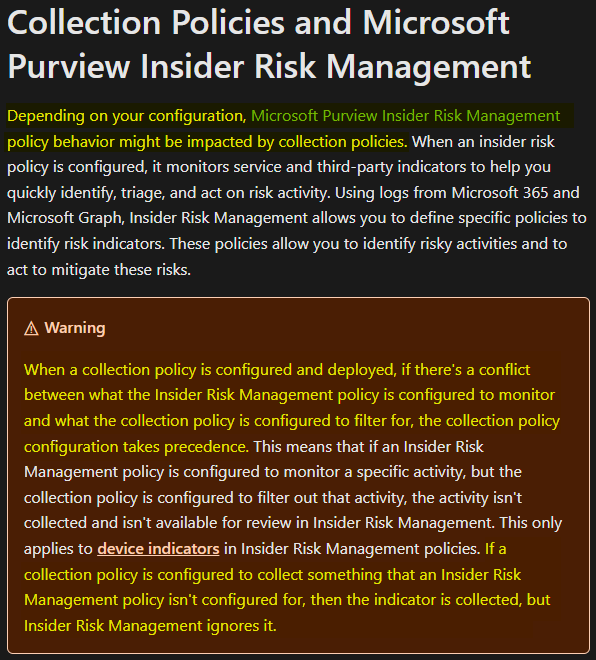
If there's a conflict, the Collection Policy wins.
IRM never even sees the event.
In Practice...
Let's say you configure an IRM policy to monitor file printing. Maybe you want to catch users printing sensitive documents. Sounds reasonable. But upstream, your Collection Policy is configured to filter out print events entirely.
What happens?
Nothing! The sensitive print event is never collected, and the IRM policy never sees it. If the Collection Policy doesn't collect it, IRM cannot process it, even if it's explicitly configured to.
Here's a simple table with a couple scenarios to help map it out:
| Collection Policy Action | IRM Policy Action | What Actually Happens |
|---|---|---|
| Filters out an activity | Tries to monitor it | IRM sees nothing, and the Collection Policy blocks it |
| Collects an activity | Doesn't monitor it | IRM ignores it (no case is generated) |
The hierarchy looks like this:
Device Activity → Collection Policy → IRM Policy → Alerts
Lab Scenario...
These things are usually better understood when you break them yourself. So, open up a Dev Tenant and try this:
- Set up a Collection Policy that excludes file copy to USB.
- Set up an IRM Policy that monitors file copy to USB.
- On an onboarded Device, perform the triggering activity.
- Note what happens.
- (Hint: i bet it's nothing)
If anything, remember this...
If Collection Policies don't allow it, IRM can’t see it. If IRM doesn't monitor it, it sees it but throws it away.
This means you can easily configure a false sense of monitoring. This is especially true in orgs where policy teams and device data collection teams aren’t tightly aligned.
So, If you're wondering why your IRM alerts are so quiet lately...check your Collection Policies. They might disappoint you.