Bridging NIST’s AI Risk Management Framework with Microsoft Purview Data Security

Hello again.

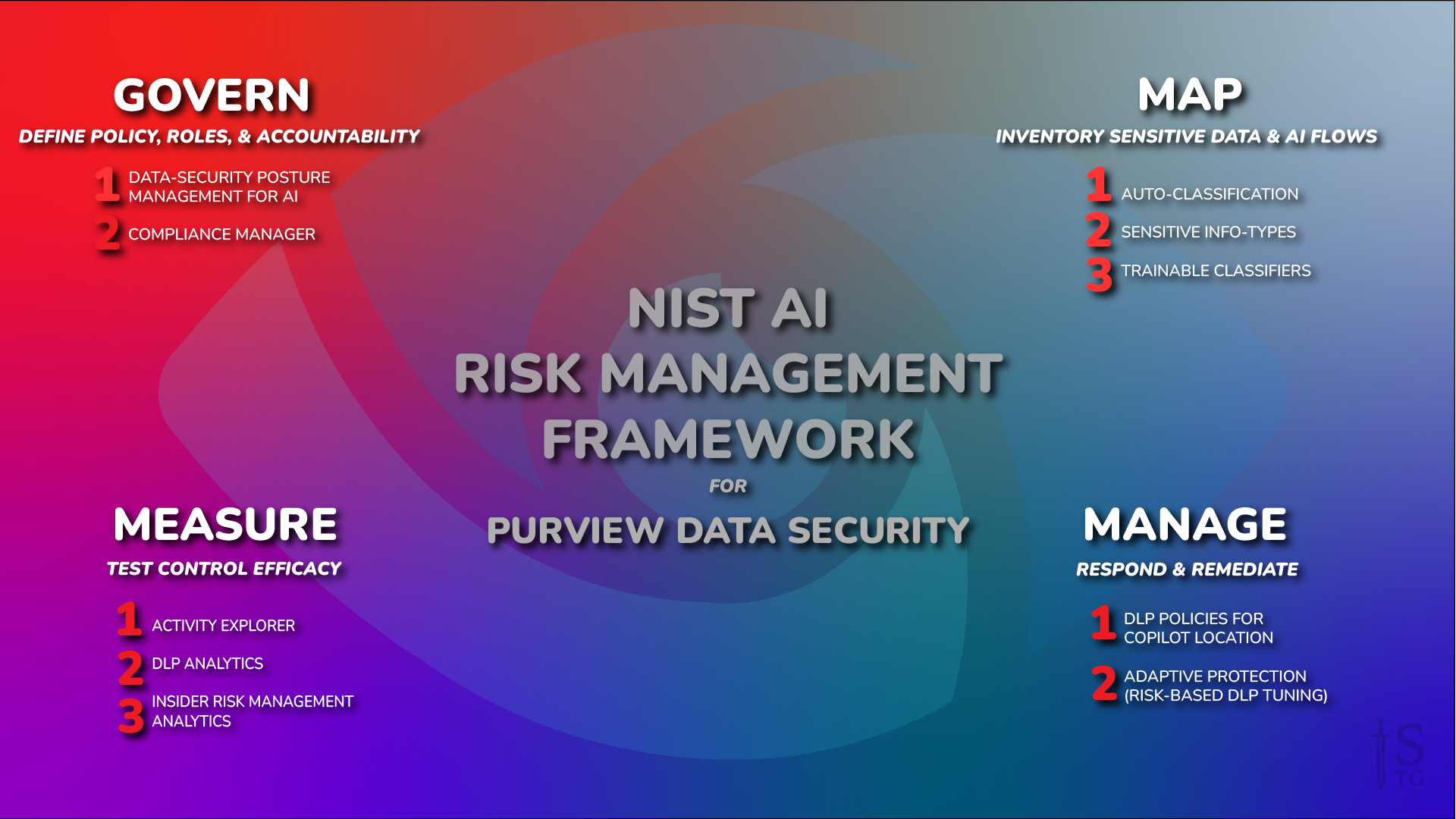
Rapid AI adoption is really pushing security teams to prove control effectiveness. NIST’s AI Risk Management Framework (AI RMF) offers guidance around this, but you still need reliable tech to actually apply said guidance. I cobbled together a minimalist infographic that distills the match-up for Data Security Professionals or anyone else in the industry that's responsible for securing their data against AI leaks.
The table below expands on it a bit:
The four functions in practice
| RMF Function | Purview Control to Start With |
|---|---|
| Govern Define policy, roles, accountability | Data-Security Posture Management for AI delivers one-click Copilot capture policies and policy-gap recommendations. |
| Map Inventory sensitive data and AI flows | Auto-classification, Sensitive Info-Types, and Trainable Classifiers expose what Copilot and other services can touch. |
| Measure Test control efficacy | Activity Explorer, DLP Analytics, and Insider-Risk Analytics verify label actions, incident rates, and user risk trends. |
| Manage Respond and remediate | DLP policies scoped to the Microsoft 365 Copilot location, plus Adaptive Protection, block or quarantine risky content and tune enforcement by user risk level. |
As you can see, Purview gives you immediate coverage and you can demo every control above today with minimal effort. Mapping the RMF to concrete Purview features also counters the “show me” request from auditors and executives.
Never fear another audit!
-Nobody
I've got tools brewing in the pipeline that will help deepen the Measure and Manage parts of the framework, but you don't need them to earn quick wins now. If you have any questions or are generally confused about applying this NIST Framework to your Purview tenant, shoot me a message.